
August 10, 2026
What Is LVP Flooring Made Of? Every Layer of Luxury Vinyl Plank, Explained
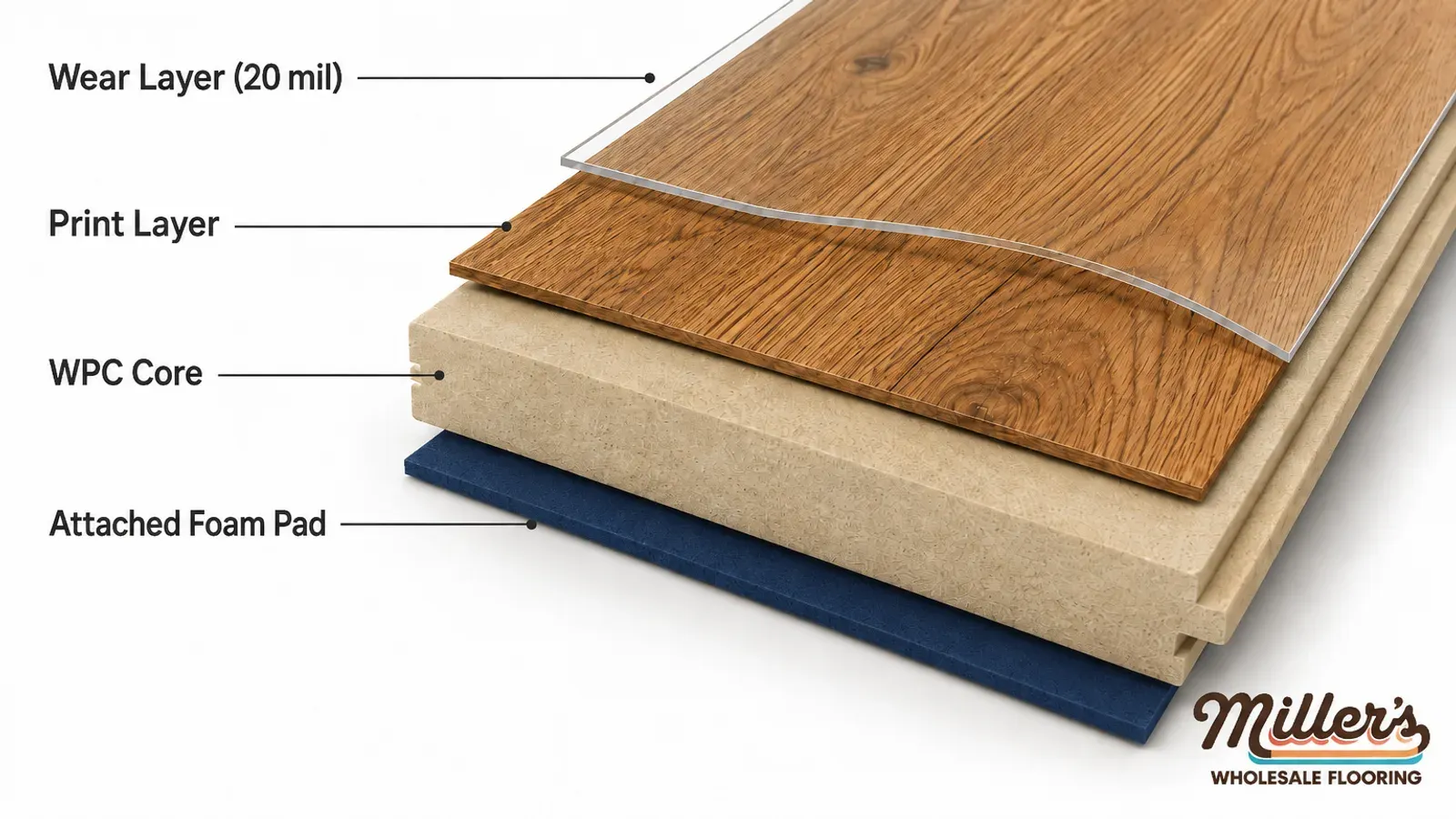
Luxury vinyl plank is built in four layers: a clear wear layer on top, a printed design layer under it, a rigid or flexible vinyl core in the middle, and, on most planks sold today, an attached underlayment pad on the bottom. That's the whole cross-section. Each layer has one job, and once you know what each one does, comparing two planks in a showroom stops being guesswork.
That matters because the poster over the display only says "Pet Proof and Waterproof," and nearly every plank sold today can claim both. The four layers are where a floor that lasts separates itself from one that only photographs well.
We've sold and installed LVP all over East Tennessee for years, and the questions below are the ones customers actually ask us at the counter in Madisonville. Here's every layer, top to bottom.
The wear layer: the part you walk on
The wear layer is a clear urethane coating on the very top of the plank, and it's the single most important number on the box. It's measured in mils, which are thousandths of an inch, not millimeters. You'll see planks out there anywhere from 6 mil to 40 mil, and higher is better: this layer is what stands between your floor's finish and the kids, the dogs, and the gravel on somebody's boots.
Our own line in the sand for the home you live in: we recommend a 20 mil wear layer or better, just about every time. Decades of installs have taught us that thinner wear layers are where "waterproof, pet-proof" floors quietly fail early. We do stock some 12 mil SPCs for flippers and property managers, where the math is different, but for your own house we'll point you at 20 and up. If two planks look identical and one is cheaper, check this number first. The savings usually live in the wear layer, and so does the regret.
If you remember one thing from this article: pay for the wear layer, not the picture.
The design layer: the picture
Under the clear coat sits a high-resolution printed film. This is the layer that makes a vinyl plank look like hickory, oak, or stone. Modern printing is good enough that we regularly have customers kneel down and touch a floor before they believe it isn't wood. Better planks pair the print with embossed texture that follows the grain in the picture, so it feels like what it shows.
The design layer is why two planks with identical construction can sit at different prices. Better planks span the print across sixty square feet or more before it repeats, so the floor reads as a real floor once it's laid out instead of showing you the same three boards over and over.
The core: SPC vs. WPC
The core is the thick middle of the plank, and it's where the two big families of LVP split:
- WPC (wood-plastic composite): vinyl mixed with a wood-flour foaming agent. Thicker, quieter, warmer, and softer underfoot. In our experience it's also the more forgiving core when the seasons change.
- SPC (stone-plastic composite): vinyl mixed with powdered limestone. Dense and rigid, and the right tool for specific jobs. More on that below.
Neither core contains actual planks of stone or wood. Both are engineered vinyl composites, both are waterproof through the core, and both stand up to real household traffic. The difference that matters is how they live with your subfloor and your climate.
Our recommendation after years of installs in East Tennessee: WPC for homes, just about everywhere. Our climate swings from humid summers to cold snaps, and floors here expand and contract with it. WPC handles that movement much better than SPC. We've watched WPC floors hold up beautifully through Tennessee seasons where SPC struggles. On a wood subfloor especially, a WPC will outlast an SPC by a wide margin, and even over residential concrete we'd still point you to WPC. Where SPC earns its keep is commercial work, and there we'd usually recommend a glue-down SPC rather than a floating floor, so a storefront's rolling loads and traffic have a floor that's anchored, not drifting. We wrote a whole piece on why WPC earns its price: Why buy a WPC?
When should I get SPC?
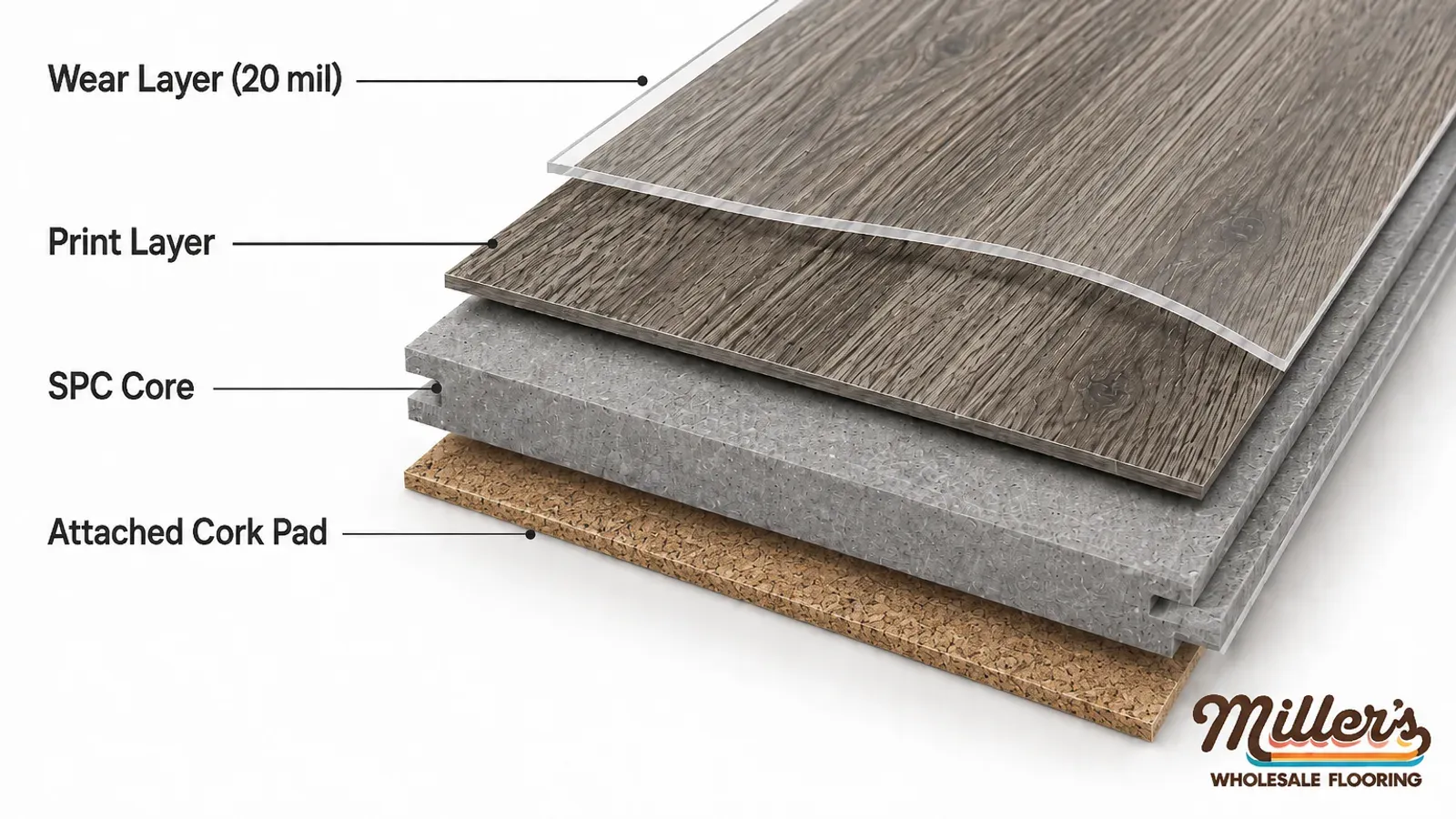
As you can probably tell, we're not the biggest fans of SPC for homes, but SPC absolutely has its place and its value. A floating SPC is a great fit for rentals and for tighter budgets: it's generally a more affordable product than WPC, it goes down fast, and on a flat, level slab it really does hold up well. If you're flooring a rental unit on a slab and the numbers matter, a floating SPC is an honest choice we'll happily sell you. And for commercial spaces, as we said above, glue-down SPC is our standard recommendation.
The attached underlayment: the bottom pad
Most LVP sold today comes with a thin pad, usually cork or foam, already glued to the bottom of the plank. It softens footfall, quiets the hollow "click" sound floating floors can make, and smooths over tiny imperfections in the subfloor. The three we've seen hold up best:
- iXPE foam — a dense cross-linked foam that quiets footsteps and overlaps at the joints for moisture protection.
- Natural cork — what COREtec uses. Warmer and quieter, and naturally mold and mildew resistant.
- Action back — a ridged foam that adds stability underfoot.
Can you add another underlayment under a plank that already has a pad? That depends on the plank, and we mean that as a real answer rather than a dodge. Some floors take a thin underlayment underneath with no trouble at all. On others it's the wrong move, and the reasons are specific to the product. It isn't a rule you can read off the internet and apply to whatever is in your cart.
Where we do consistently recommend one is over concrete. There's an underlayment we use on our own slab installs that adds a real moisture barrier along with warmth and quiet. Ask us about it when you're pricing a concrete-slab project, and tell us which plank you're looking at so we can tell you what belongs under it.
How is luxury vinyl plank actually made?
The layers are made separately and then fused under heat and pressure. The core is extruded first (that's where SPC gets its limestone and WPC gets its foaming agent), then the printed design film is bonded to the top of it, the clear wear layer is applied over the print and cured, and the click-lock edges are milled into the finished plank last. The attached pad goes on at the end. That fusing is why a quality plank doesn't delaminate: it isn't glued like a sandwich, it's bonded into one piece.
What the layers mean when you're buying
When you're standing in front of two boxes at different prices, here's how the layers explain the difference:
- Check the wear layer first. A beautiful 6-mil plank is a short-term floor. 20 mil buys years, and it's the minimum we recommend for a home.
- Match the core to the job. For a home, any room and any subfloor, we recommend WPC; it rides out East Tennessee's humidity and temperature swings far better. For a commercial space, glue-down SPC.
- Look at the print repeat. Lay out three planks in the store. If the pattern obviously repeats, it'll repeat across your whole floor.
- Note the pad. Attached underlayment quiets and cushions the floor. On concrete, ask about the extra underlayment we install beneath it.
Wear layer for the years, picture for the look, core for your setting, pad for the comfort. Read those four numbers and you'll know more than the poster does.
Still weighing whether LVP is right for your rooms? Read the myths worth ignoring, and if you've already narrowed it down to core type, WPC vs SPC: Which One Should You Buy? settles that one. Or come stand on the real thing in our Madisonville showroom and see the LVP lines we carry and install. If you'd like straight answers about your own rooms, request a free estimate and we'll bring samples to you.
Planning a flooring project?
We supply and install across East Tennessee. Most estimates are scheduled within 1–2 business days.